FSSAI Registration for Home Bakers in Pune: What Changed in 2026 and How to Apply
Running a home bakery in Pune? Here's how FSSAI registration works after the April 2026 changes, what it costs, and how to apply on FoSCoS.
Artikel ini tersedia dalam bahasa Inggris.

If you bake cakes at home in Pune and sell them, even only to friends of friends on WhatsApp, you need an FSSAI registration. The good news is that it got a lot easier this year.
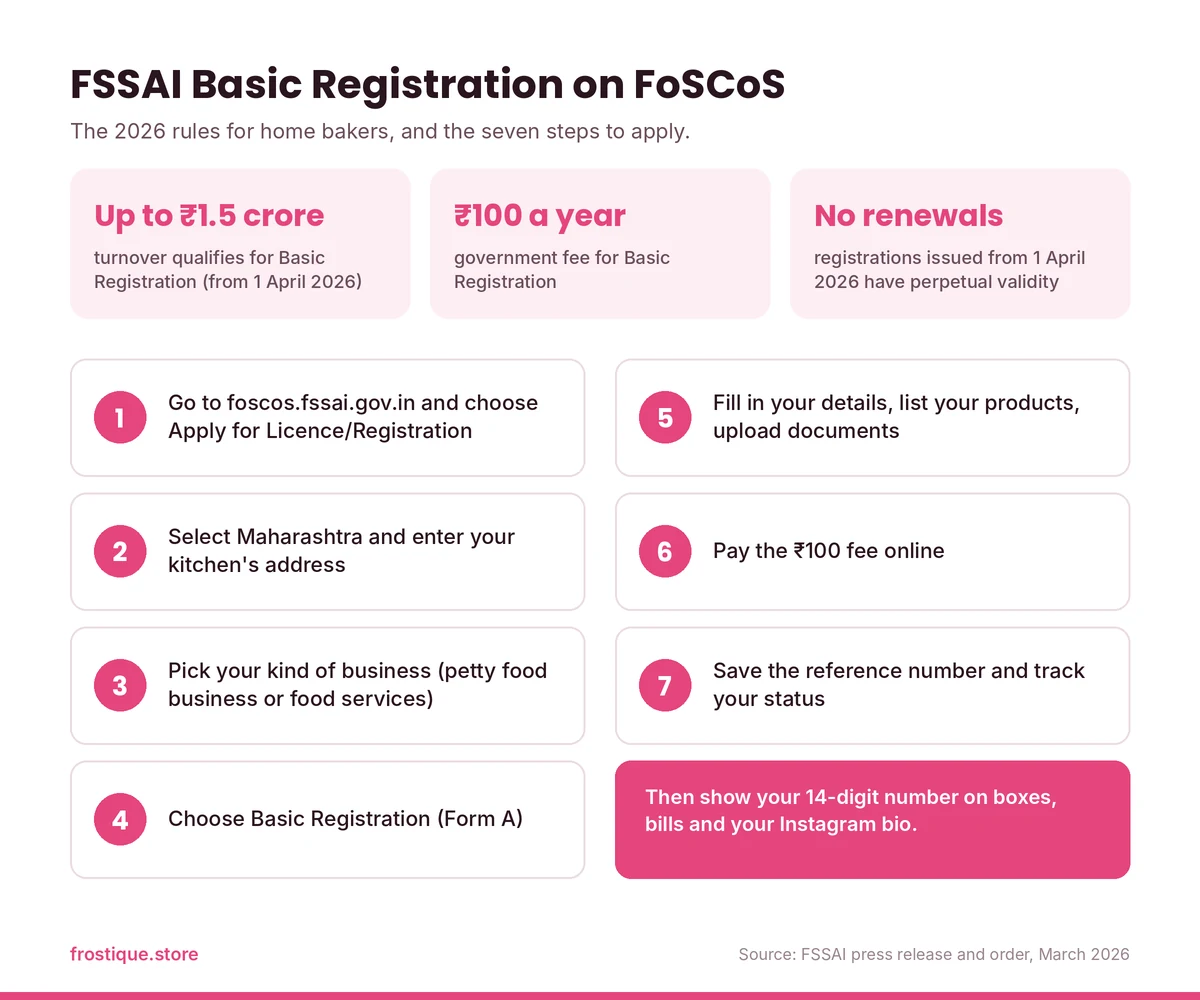
In March 2026, FSSAI announced two changes that matter to almost every home baker. The turnover limit for basic registration went up from ₹12 lakh to ₹1.5 crore from 1 April 2026. And registrations issued from that date have perpetual validity, which means no more renewing every few years. (FSSAI press release)
We talk to a lot of home bakers in Pune, from Kondhwa to Wakad, and the same worry comes up again and again: "Is my kitchen even allowed? Will someone come and inspect my house?" So here's the plain version.
Do you actually need it?
Yes, if you sell food. It doesn't matter that you work from home, that you only take a few orders a week, or that your customers are people you know.
There's also a practical reason. Swiggy and Zomato won't list you without an FSSAI number, and more customers are asking for it before they order a birthday cake for their kids. A 14-digit number on your cake box and Instagram bio does a lot of quiet work for you.
Which one do you need: registration or licence?
From 1 April 2026, FSSAI uses these turnover bands:
| Annual turnover | What you need |
|---|---|
| Up to ₹1.5 crore | Basic Registration |
| Above ₹1.5 crore, up to ₹50 crore | State Licence |
| Above ₹50 crore | Central Licence |
Source: FSSAI order and FAQs, March 2026
A home baker in Pune is almost always in the first row. Even a busy home bakery doing ₹1.5 lakh a month is around ₹18 lakh a year, nowhere near the limit.
One thing that trips people up: you'll still find plenty of websites saying the basic limit is ₹12 lakh. That was the old rule. If you were holding off because you thought you'd crossed ₹12 lakh and needed a State Licence, check again.
What it costs
The government fee for Basic Registration is ₹100 a year. That's the whole government cost.
Agents in Pune will offer to file it for ₹1,500 to ₹3,000. You can pay that if you'd rather not deal with the portal, but the form is short and most bakers get through it in an evening.
Documents to keep ready
Have these scanned (PDF or JPG) before you start:
- A recent passport-size photo
- Photo ID: Aadhaar, PAN, voter ID or passport
- Proof of address for your kitchen: electricity bill, rent agreement, or property tax receipt
- If you rent: a no-objection letter from the owner helps, though it isn't always asked for
- The list of products you'll sell (cakes, cookies, brownies, and so on)
Your home address is fine as the business address. You don't need a shop or a commercial kitchen for Basic Registration.
How to apply on FoSCoS, step by step
Everything happens on the FoSCoS portal at foscos.fssai.gov.in. Pune applications go to the Maharashtra food safety authority automatically based on your address.
- Go to foscos.fssai.gov.in and choose "Apply for Licence/Registration".
- Select Maharashtra as your state and enter your kitchen's address.
- Pick your kind of business. Home bakers usually fall under petty food business or food services. If you're unsure, the portal's eligibility check walks you through it.
- Choose Basic Registration (Form A).
- Fill in your details, list your products, and upload the documents above.
- Pay the ₹100 fee online.
- Save the application reference number. You'll need it to track status.
Once approved, you can download the certificate from the same portal. FSSAI said in March that the reforms are meant to make registration instant for small businesses and remove pre-inspection, though in practice some applications still take a few working days.
After you get the number
Put it where customers will see it:
- On your cake box sticker or label
- In your Instagram bio and WhatsApp Business profile
- On your website or online menu
- On your bills
Perpetual validity means you don't renew. But it's tied to your premises. If you move from your flat in Hadapsar to a new place in Undri, update the address on FoSCoS.
A few honest notes
Registration doesn't mean nobody will ever check. FSSAI moved to risk-based inspections, so they can still visit, especially after a complaint. Keep your kitchen clean, store cream and dairy properly, and don't keep raw meat next to your cake ingredients.
Also, FSSAI is separate from GST. Most home bakers don't need GST at the start. But if you want to sell through Swiggy or Zomato, they may ask for it during onboarding, so read their current requirements before you sign up.
Pertanyaan yang sering diajukan
Can I register a home kitchen in a housing society in Pune?
Yes. FSSAI Basic Registration is about your food business, not your society. Some societies have their own rules on running businesses from flats, so check your society bye-laws separately.
My registration was issued before April 2026. Do I renew?
Registrations expiring before 31 March 2026 needed renewal under the old rules. If yours was renewed or issued after 1 April 2026, it has perpetual validity. Check your certificate on FoSCoS.
Do I need a separate registration for Instagram orders?
No. One registration covers your kitchen, however you take orders.
How long does it take?
Usually a few working days. If the portal raises a query, reply quickly; most delays come from blurry document scans.
Once you're registered, the next headache is usually orders: a dozen WhatsApp chats, three Instagram DMs, and one customer who called while you were piping roses. Frostique gives you a free online shop at yourshop.frostique.store where customers browse your cakes and order, and every order lands on one live board. The free plan covers up to eight products, with 0% commission.